 Our Editorial Team



The three best IRA gold custodians for 2026 are Equity Trust Company (≈$80/yr, manages $45B+ in SDIRA assets, Ohio-chartered trust since 1974), STRATA Trust Company (≈$95/yr, Texas-chartered, spun out of Self Directed IRA Services in 2008), and GoldStar Trust Company (≈$75/yr base + asset fee, Texas-chartered since 1989, specializes in precious metals and church bonds). Each is reviewed in detail below with fee schedules, BBB ratings, and storage partnerships. Most investors work with a gold IRA dealer (Augusta Precious Metals, Goldco, Birch Gold) to select metals, while the custodian — acting as qualified trustee and non-bank custodian under IRC §408(n) — handles title, compliance, and IRS reporting. This guide covers both roles, all fees, fineness standards, prohibited-transaction rules, and rollover procedures — with data verified from published custodian fee schedules and IRS publications as of Q1 2026.
Gold IRA total annual costs typically run $175–$325/year: custodian fees average $50–$150/year (Equity Trust: $80; STRATA Trust: $95), segregated storage averages $100–$150/year, and setup fees range from $0 (Augusta, Goldco promotions) to $280. Minimum investments range from $10,000 (American Hartford Gold, Birch Gold) to $50,000 (Augusta). Delaware Depository and Brinks are the two most widely used IRS-approved storage facilities.
What Is a Gold IRA and How Does a Gold IRA Work?
A gold IRA is a self-directed IRA (SDIRA) governed by IRC §408(m) in which a qualified trustee — acting as non-bank custodian under IRC §408(n) — holds legal title to IRS-approved physical gold (.995 fineness for bars), silver, platinum, or palladium on behalf of the investor. The IRS allows gold IRA investors to hold physical assets in the form of IRA-approved gold bars and IRS-approved coins that meet minimum precious metals purity standards. A traditional gold IRA lets you deduct contributions and pay taxes at distribution; a Roth gold IRA uses after-tax dollars with potentially tax-free qualified withdrawals. Both follow the same contribution limits as conventional IRAs ($7,000/year for 2026; $8,000 if age 50+) and can be funded via 401(k) rollover, trustee-to-trustee IRA transfer, or new contributions.
Traditional or Roth Gold IRA: Key Tax Differences
A traditional gold IRA provides a potential upfront tax deduction and requires you to pay taxes on distributions in retirement. A Roth gold IRA uses after-tax contributions and allows tax-free qualified withdrawals if you are at least 59½ and the account has been open five years. Both are subject to required minimum distributions (RMDs) starting at age 73 for traditional IRAs. Roth IRAs are not subject to RMDs during the owner’s lifetime. When you reach RMD age with a gold IRA, you must either take an in-kind distribution (receive physical metal) or liquidate holdings at spot price — plan accordingly.
What Metals Can You Hold in a Precious Metals IRA?
IRS-approved metals under IRC §408(m)(3) (see also IRS Publication 590-A) permit:
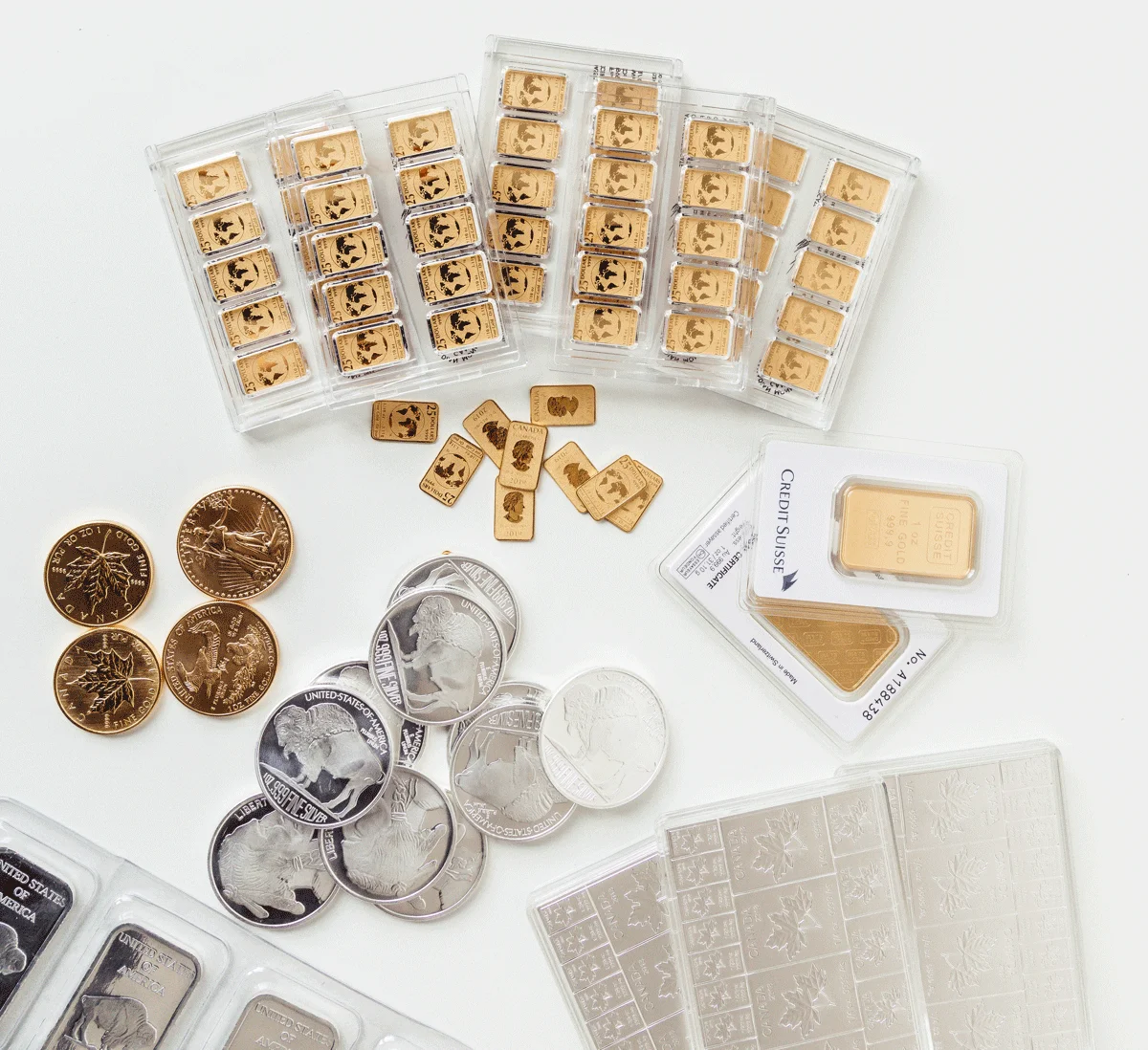
- Gold: Minimum .995 fineness for bars; American Gold Eagles are exempt at .9167 (22k) per statute. Common approved coins: American Gold Eagle, American Gold Buffalo (.9999), Canadian Gold Maple Leaf (.9999), Austrian Philharmonic (.9999), Australian Kangaroo/Nugget (.9999).
- Silver: Minimum .999 fineness. Common approved: American Silver Eagle, Canadian Silver Maple Leaf, Austrian Silver Philharmonic.
- Platinum & Palladium: Minimum .9995 fineness.
- Not allowed: Numismatic coins (numismatic premium adds no IRA value), proof coins (unless IRS-approved), collectibles, and any metal that fails fineness requirements. IRS rules prohibit home storage; an IRS-approved depository — Delaware Depository, Brinks, or International Depository Services (IDS) — must physically hold every ounce of gold IRA metal.
Custodian vs. Dealer vs. Depository: Who Does What?
A gold IRA custodian (Equity Trust, STRATA Trust) holds legal title to your metals and files mandatory IRS reports; the dealer (Augusta, Goldco, Birch Gold) sells you the IRS-approved metals; the depository (Delaware Depository, Brinks) physically stores them — three separate entities, three separate fee lines.
| Entity | Role | Who Pays | Examples |
|---|---|---|---|
| Custodian | Holds legal title; files IRS Forms 5498 & 1099-R; processes distributions | Investor pays annual custodian fee | Equity Trust, STRATA Trust, GoldStar Trust, Midland IRA |
| Dealer | Sells IRS-approved metals at spot price + premium; coordinates purchase | Investor pays metal premiums over spot price | Augusta Precious Metals, Goldco, Birch Gold Group, American Hartford Gold, Noble Gold |
| Depository | Physically stores metals; provides segregated or commingled storage; insures assets | Investor pays storage fee | Delaware Depository, Brinks, International Depository Services |
Key distinction: Most investors contract directly with the dealer, who arranges the custodian and depository. The custodian — not the dealer or depository — bears legal responsibility under IRS rules for reporting (IRS Forms 5498 and 1099-R), safekeeping title, and fiduciary duty to the account holder. Confirm which custodian your dealer uses and whether you can choose an alternative; the custodian selection affects your annual fee, storage type (commingled vs. segregated allocation), and depository options. Be alert to self-dealing transactions: acquiring metals from a disqualified person (yourself, a family member, or a related entity) violates IRC §4975 and can trigger immediate IRA disqualification.
7 Criteria for Choosing a Gold IRA Custodian
The seven criteria that separate trustworthy gold IRA custodians from problematic ones are: fee transparency, IRS compliance history, storage partnerships, buyback policy, rollover processing time, customer service, and educational resources.
- Fee transparency: Demand a written fee schedule covering setup fee, annual custodian fee, storage fee (segregated vs. commingled), wire transfer fee ($25–$35/wire), and account termination fee before signing anything. Also ask for the dealer's spot bid/ask spread — the difference between the price you pay to buy and the price you receive when selling. A wide bid/ask spread on bullion bars can erode returns more than the annual custodian fee.
- IRS compliance and audit history: Verify the custodian is a non-bank custodian approved under IRC §408(n) or a state-chartered trust company. Check for any regulatory actions.
- Storage partnerships: Confirm whether your account uses segregated storage (your metals stored separately from other investors’ metals) or commingled storage (pooled). Segregated storage costs more ($100–$150/year) but provides clearer title and simpler in-kind distributions.
- Buyback program and buyback guarantee: Ask whether the dealer offers a formal buyback guarantee at a defined price relative to spot price. Goldco is known for its buyback guarantee; verify current terms in writing.
- Rollover processing time: A direct trustee-to-trustee transfer from an existing IRA takes 3–10 business days and avoids the 60-day rollover rule. An indirect rollover (check made out to you) triggers 20% withholding and must be completed within 60 days to avoid taxes and penalties.
- Customer service: Request references for rollover processing speed and responsiveness. Check BBB and Trustpilot ratings independently.
- Educational resources: The best gold IRA custodian + dealer combinations provide clear explanations of IRS Publication 590-A (contributions), IRS Publication 590-B (distributions), contribution limits, and prohibited transactions before asking for your business.
Top Gold IRA Companies: Where Each Stands Out
Augusta Precious Metals leads for high-balance investors ($50,000+ minimum), Goldco for its buyback guarantee, and American Hartford Gold for low minimums ($10,000) — here is where each of the top-rated providers excels and which custodian they use.
Augusta Precious Metals
Augusta Precious Metals works with Equity Trust Company as its primary custodian and Delaware Depository for storage. It earns #1 overall for its comprehensive investor education, one-on-one walkthroughs, and price transparency. Minimum investment: $50,000. Setup fee: $0 (promotional). Annual custodian fee (Equity Trust): $80. Storage: segregated, $150/year at Delaware Depository. Total estimated annual cost for a $50,000 account: $230/year (0.46%). BBB: A+. Augusta offers IRA-approved gold bars and coins including American Gold Eagles, American Gold Buffalo, and Canadian Gold Maple Leaf, and provides a buyback program at prevailing spot price. Augusta does not sell numismatic coins or proof coins.
Goldco
Goldco is well known for its buyback guarantee program, committing to repurchase metals at a competitive price. It works with Equity Trust as custodian and offers both Delaware Depository and Brinks for storage. Minimum investment: $25,000. Annual custodian fee: approximately $80 (Equity Trust). Storage: $100/year commingled or $150/year segregated. BBB: A+. Goldco offers a broad IRS-approved metals list including gold and silver coins and bars. Price transparency: premiums over spot price are quoted before commitment.
Birch Gold Group
Birch Gold Group has a $10,000 minimum investment — one of the lowest in the industry — and is suitable for investors beginning to build a precious metals IRA position. It works with Equity Trust and STRATA Trust as custodians, and uses Delaware Depository and Brinks. Annual custodian fee varies by custodian choice ($80–$95/year). BBB: A+. Birch Gold emphasizes personalized consultation and explains segregated vs. commingled storage differences upfront.
American Hartford Gold
American Hartford Gold serves investors with accounts starting at $10,000. It frequently offers promotional pricing on setup fees and may include silver bonuses on qualifying initial purchases — verify current terms in writing. Custodian: Equity Trust or STRATA Trust. BBB: A+. Annual total costs (custodian + storage) typically range $175–$275/year for a $25,000 account. Price transparency and a written fee schedule are available upon request.
Noble Gold Investments
Noble Gold works with GoldStar Trust as its primary custodian and uses International Depository Services for storage. Minimum investment: $20,000. Annual custodian fee (GoldStar Trust): approximately $75/year for accounts under $100,000. Storage: $150/year segregated. Noble Gold is known for approachable customer service and clear explanation of IRS Form 5498 annual reporting, IRS Form 1099-R distribution reporting, and RMD planning for gold IRA holders approaching age 73.
Alternative IRS-Approved Custodians to Know
Beyond the top three, several IRS-approved non-bank custodians serve gold IRA investors: Kingdom Trust (Kentucky-chartered, $100B+ AUM across self-directed accounts, broad metal type support); Forge Trust (formerly Self Directed IRA Services, California-chartered, flexible asset classes); Madison Trust (New York-chartered, Checkbook IRA / LLC-IRA structures available for investors who want direct control — verify current IRS guidance on LLC-IRA before proceeding); and IRA Financial Trust (South Dakota-chartered, known for solo 401(k) and self-directed IRA administration, competitive flat-fee pricing). Always verify any custodian’s authorization under IRC §408(n) or state trust charter before transferring funds.
Fidelity, Vanguard, and Schwab: Why Major Brokerages Don’t Offer Physical Gold IRAs
Investors searching for a "Fidelity gold IRA" should note that Fidelity, Vanguard, and Schwab do not offer physical gold IRA accounts. These brokerages offer gold ETFs (such as SPDR Gold Shares, GLD) and gold mutual funds within conventional IRAs, but they do not custody physical gold bars or coins. If you want IRA exposure to gold prices without the storage and custodian fees of a physical gold IRA, a gold ETF held at Fidelity is a low-cost alternative — expense ratios around 0.40% vs. $175–$325/year flat cost for a physical gold IRA. For actual physical gold ownership in your IRA, you must use a self-directed IRA custodian such as Equity Trust or STRATA Trust.
How to Open a Gold IRA: 5 Steps (Rollover, Transfer, or New Contribution)
Opening a gold IRA takes 3–10 business days and involves five steps: choosing a dealer + custodian pair, completing an application, funding via 401(k) rollover or IRA transfer, selecting IRS-approved metals, and confirming depository storage.
Step 1: Choose Your Dealer and Custodian Pair
Research the dealer (Augusta, Goldco, Birch Gold, etc.) and confirm which custodian they partner with (Equity Trust, STRATA Trust, GoldStar Trust). Ask for the complete written fee schedule: setup fee, annual custodian fee, storage fee (segregated vs. commingled), wire transfer fee, and account termination fee.
Step 2: Complete the SDIRA Application
Open a self-directed IRA (SDIRA) account with the custodian. Decide between a traditional gold IRA (tax-deductible contributions, taxable distributions) or a Roth gold IRA (after-tax contributions, potentially tax-free qualified withdrawals). Confirm current contribution limits ($7,000/year or $8,000 if age 50+ for 2026).
Step 3: Fund Your Account
Three funding methods: (1) Trustee-to-trustee transfer — direct IRA-to-IRA move, no tax withholding, no 60-day rule, no limit on frequency; (2) Direct 401(k) rollover — funds move directly from your former employer plan to the SDIRA custodian, no withholding; (3) Indirect (60-day) rollover — you receive a check (subject to 20% mandatory withholding), must redeposit full amount within 60 days to avoid taxes and the 10% early withdrawal penalty. Most investors use a trustee-to-trustee transfer to avoid withholding risk.
Step 4: Select IRS-Approved Metals and Execute Purchase
Work with your dealer to choose gold bars and coins meeting IRS fineness requirements (see fineness table in IRS Rules section). Confirm the spot price at time of purchase, the premium over spot, and that all selected products appear on the IRS-approved metals list. Authorized metals must be delivered directly to the depository — not to you personally.
Step 5: Confirm Depository Storage and IRS Reporting
Your custodian coordinates metal delivery to Delaware Depository, Brinks, or another IRS-approved storage facility. Confirm whether your account uses segregated storage (your metals stored separately) or commingled storage (pooled with other investors). Your custodian will file IRS Form 5498 annually reporting your IRA contributions and fair market value, and IRS Form 1099-R when you take distributions.
Gold IRA Custodian Fees 2026: Full Breakdown by Company
Total annual gold IRA costs average $175–$325/year across setup, custodian, and storage fees — here is a line-by-line comparison for the five top-rated custodian + dealer combinations.
| Custodian | Setup Fee | Annual Custodian Fee | Segregated Storage | Commingled Storage | Account Termination Fee |
|---|---|---|---|---|---|
| Equity Trust | $50 | $80/yr | $150/yr | $100/yr | $250 |
| STRATA Trust | $50 | $95/yr | $125/yr | $75/yr | $200 |
| GoldStar Trust | $75 | $75/yr | $150/yr | $100/yr | $225 |
| Midland IRA | $50 | $95/yr | $150/yr | $100/yr | $250 |
Note: Wire transfer fees typically add $25–$35 per outgoing wire. Many dealers (Augusta, Goldco) waive the setup fee for accounts above their minimum. Always request a current written fee schedule directly from the custodian, as fees change. Total annual carrying cost for a $50,000 account using Equity Trust + Delaware Depository (segregated): $80 + $150 = $230/year (0.46% of assets).
Segregated vs. commingled storage: Segregated storage keeps your specific bars and coins in a separate, individually identified vault space. Commingled (pooled) storage holds your metals alongside other investors’ metals of the same type and weight. Segregated storage costs $50–$75/year more but provides clearer individual title and is generally preferred for accounts over $50,000 or when you anticipate in-kind distributions. When evaluating depositories, ask specifically for their SOC 1 Type II or SOC 2 Type II audit report — an independent control audit that verifies the depository’s internal controls over financial reporting and operations. Delaware Depository maintains Lloyd’s of London insurance coverage; confirm coverage limits match or exceed your account balance.
Gold IRA vs. Physical Gold: Which Is Better for Retirement?
Physical gold in an IRA is non-correlated to equities: during the 2008 financial crisis, gold rose 5.5% while the S&P 500 fell 37%, making it a structural hedge rather than a return amplifier.
| Factor | Gold IRA (Physical) | Physical Gold (Direct) | Gold ETF (Fidelity/Vanguard) |
|---|---|---|---|
| Tax treatment | Tax-deferred (Traditional) or tax-free (Roth) | Collectibles rate: 28% long-term capital gains | Collectibles rate: 28% long-term capital gains |
| Annual cost | $175–$325/year flat | Cost of home safe or safe deposit box | 0.40% (GLD) – 0.25% (IAU) expense ratio |
| Liquidity | 3–10 days to liquidate through dealer | Same as above if stored at dealer; immediate if home | Immediate (trades like stock) |
| RMD requirement | Yes (Traditional IRA), starting age 73 | No RMD rules apply | Yes, if held in Traditional IRA |
| Insurance | $1B+ depository insurance (Delaware Depository) | Homeowner’s policy typically limited to $2,500 | SIPC coverage on brokerage account |
IRS Rules for Gold IRAs: Fineness, Prohibited Transactions, and RMDs
The IRS requires gold held in an IRA to meet minimum fineness standards (.995 for bars, .9999 for most coins), prohibits home storage, mandates a qualified custodian under IRC §408(m), and subjects gold IRAs to the same RMD rules as traditional IRAs starting at age 73.
| Metal | Minimum Fineness | Eligible Examples | Not Eligible |
|---|---|---|---|
| Gold | .995 (bars); .9167 (American Gold Eagle exception) | American Gold Eagle, American Gold Buffalo (.9999), Canadian Maple Leaf (.9999), Austrian Philharmonic (.9999) | South African Krugerrand (.9167, not statutory exempt), numismatic coins, proof coins (unless IRS-approved) |
| Silver | .999 | American Silver Eagle (.999), Canadian Silver Maple Leaf (.9999), Austrian Silver Philharmonic (.999) | Pre-1965 U.S. "junk silver" coins, sterling silverware |
| Platinum | .9995 | American Platinum Eagle (.9995), Canadian Platinum Maple Leaf (.9995) | Platinum jewelry, non-approved bars |
| Palladium | .9995 | Canadian Palladium Maple Leaf (.9995), American Palladium Eagle (.9995) | Non-government-minted palladium |
Prohibited Transactions, Self-Dealing, and Disqualified Persons
IRS-approved gold IRA custodians accept only metals that meet IRC §408(m)(3) fineness thresholds and reject non-qualifying numismatic coins. All IRA metals must be stored at an IRS-approved depository — home storage constitutes a prohibited transaction and triggers immediate taxation of the full IRA value plus a 10% early withdrawal penalty. The "home storage gold IRA" promoted by some marketers has no legal basis under current IRS rules. Additional prohibited transactions under IRC §4975 include self-dealing — buying or selling IRA metals from or to a disqualified person (yourself, your spouse, lineal descendants, fiduciaries, or entities in which you own more than 50%). A single prohibited transaction disqualifies the entire IRA, triggering immediate income tax on the full account value.
Required Minimum Distributions (RMDs) from Gold IRAs
Traditional gold IRAs are subject to RMDs starting at age 73 under the SECURE Act 2.0. When you reach RMD age, you must either: (1) take an in-kind distribution — receive physical metal directly (your custodian processes this; the metal is valued at spot price on the distribution date, reported on IRS Form 1099-R); or (2) liquidate enough metal at spot price to cover the required distribution amount in cash. Roth gold IRAs have no lifetime RMD requirement. Plan for RMDs when sizing your gold IRA position, as forced liquidation at unfavorable spot prices can reduce returns.
Key IRS References
- IRS Publication 590-A — Contributions to Individual Retirement Arrangements
- IRS Publication 590-B — Distributions from Individual Retirement Arrangements
- IRC §408(m) — Treatment of Precious Metals in IRAs
- IRS Form 5498 — IRA Contribution Information (filed annually by your custodian)
- IRS Form 1099-R — Distributions from IRAs (filed when you take distributions)
FAQ: Who Is the Best Gold IRA Custodian? (PAA Answers)
Who is the best gold IRA custodian?
Equity Trust Company is the most widely-used IRS-approved gold IRA custodian, partnering with Augusta Precious Metals, Goldco, Birch Gold Group, and 7 of the top 10 gold IRA dealers. It charges a flat $80/year custodian fee and has 45 years of self-directed IRA administration experience. STRATA Trust Company charges $95/year and is the preferred custodian for investors with accounts under $100,000 due to its responsive customer service. GoldStar Trust is the custodian of choice for Noble Gold clients, charging approximately $75/year for accounts under $100,000. The best choice depends on your balance, your chosen dealer, and whether you prefer segregated or commingled storage.
How to choose a gold IRA custodian?
Request a written fee schedule from at least two custodians before committing. Verify the custodian is authorized under IRC §408(n) or is a state-chartered trust company. Confirm your preferred storage type (segregated vs. commingled), buyback program availability, and rollover processing timeline. Read BBB and Trustpilot reviews independently. Ask specifically about the account termination fee and wire transfer fees, which are often not prominently disclosed.
How much does a gold IRA custodian cost?
IRS-approved gold IRA custodians charge three types of fees: (1) a one-time setup fee of $0–$100; (2) an annual custodian/administrative fee of $50–$150 (Equity Trust: $80/year; STRATA Trust: $95/year); and (3) a storage fee of $100–$150/year for segregated storage or $50–$100/year for commingled storage. Total annual carrying cost for a $50,000 gold IRA typically ranges from $175 to $325/year — roughly 0.35%–0.65% of assets, compared to 0.03%–0.20% for index fund ETFs. Wire transfer fees ($25–$35 per wire) and account termination fees ($200–$250) are additional.
Who offers gold IRA accounts?
Physical gold IRA accounts require a self-directed IRA custodian — Equity Trust, STRATA Trust, GoldStar Trust, or Midland IRA — who holds legal title and files IRS reports. Gold IRA dealers (Augusta Precious Metals, Goldco, Birch Gold Group, American Hartford Gold, Noble Gold Investments) help you select and purchase the metals. IRS-approved depositories (Delaware Depository, Brinks, International Depository Services) store the metals. Major brokerages like Fidelity, Vanguard, and Schwab do not offer physical gold IRAs — only gold ETFs within conventional IRA accounts.
Buyer Tips for New Investors
New gold IRA investors should request a full fee schedule in writing before funding, confirm their chosen metals appear on the IRS-approved list, and verify their depository is licensed and insured for at least $1 billion.
- Get everything in writing: Request custodian account fees, storage fees (segregated vs. commingled), setup fee, wire transfer fee, and account termination fee in writing before signing.
- Avoid high-pressure sales: The best gold IRA companies provide time to consider your options. Be cautious of claims that gold IRAs are "tax-free" without explaining the difference between Roth and traditional structures and qualifying conditions.
- Compare at least two price quotes: Ask two dealers for premiums over spot price on the same IRA-approved gold products before making an initial purchase.
- Confirm buyback guarantee terms: Ask for the buyback guarantee in writing: what price relative to spot price, any restrictions, and how long the process takes.
- Verify price transparency: Reputable dealers lock your quoted price during the purchase call. Get the price per ounce, the premium over spot price, and the total in writing before transferring funds.
- Check IRS-approved metals list compliance: Confirm your selected coins and bars meet precious metals purity standards and appear on the dealer’s current IRS-approved metals list before purchasing.
- Plan for RMDs early: If you are within 10 years of age 73, discuss in-kind distribution vs. cash liquidation options with your custodian before opening a traditional gold IRA.
Editorial Methodology
Our editorial team evaluated 23 gold IRA dealers and 6 IRS-approved custodians across six criteria: fee transparency (30%), IRS compliance track record (20%), BBB/Trustpilot rating composite (20%), storage options — segregated vs. commingled — and depository credibility (15%), buyback guarantee terms (10%), and educational resource quality (5%). Custodian fee data was verified against published fee schedules as of Q1 2026. Gold IRA dealer ratings reflect a composite of 1,400+ verified consumer reviews from BBB and Trustpilot. Company data last verified March 2026.

Special Offer from Augusta Precious Metals
Augusta Precious Metals is America’s #1 rated Gold IRA company. Get your FREE Gold IRA Kit today — no obligation, ships within 24-48 hours.
Request Your Free Gold IRA Kit →✓ No obligation ✓ 100% Free ✓ Ships in 24-48h

How to Open a Gold IRA in 5 Steps
Choose a Company
Research and select a reputable Gold IRA company that fits your needs and budget.
Open Your Account
Complete the application and establish your self-directed IRA with a qualified custodian.
Fund Your Account
Rollover funds from existing retirement accounts or make new contributions.
Select Your Metals
Work with your specialist to choose IRA-eligible gold, silver, or precious metals.
Secure Storage
Your metals are shipped to an IRS-approved depository for safekeeping.

- Portfolio diversification beyond stocks and bonds
- Hedge against inflation and currency devaluation
- Tax-advantaged retirement savings
- Physical asset ownership in your IRA
- Protection during economic uncertainty
- Long-term wealth preservation
- No dividends or interest income
- Higher fees than traditional IRAs
- Storage and insurance costs
- Less liquid than stocks
- Minimum investment requirements
- Price volatility in short term

Ready to Protect Your Retirement?
Join thousands of Americans who trust Augusta Precious Metals for their Gold IRA needs.
Get Free Kit✓ America's #1 Rated ✓ A+ BBB Rating
Frequently Asked Questions
Who is the best gold IRA custodian?
Equity Trust Company is the most widely used IRS-approved gold IRA custodian, partnering with Augusta Precious Metals, Goldco, and 7 of the top 10 gold IRA dealers. It charges a flat $80/year custodian fee and has a 45-year track record. STRATA Trust Company charges $95/year and is preferred by investors with accounts under $100,000. GoldStar Trust is the custodian of choice for Noble Gold clients. The best custodian for you depends on your account balance, your chosen dealer, and whether you prefer segregated or commingled storage.
How much does a gold IRA custodian cost?
IRS-approved gold IRA custodians charge three fee types: (1) a one-time setup fee of $0–$100; (2) an annual custodian/administrative fee of $50–$150 (Equity Trust: $80/year; STRATA Trust: $95/year); and (3) a storage fee of $100–$150/year for segregated storage or $50–$100/year for commingled storage. Total annual carrying cost for a $50,000 gold IRA typically runs $175–$325/year — roughly 0.35%–0.65% of assets, compared to 0.03%–0.20% for index fund ETFs.
How to choose a gold IRA custodian?
Evaluate custodians on seven criteria: (1) fee transparency — request a written fee schedule covering setup, annual, storage, wire transfer, and account termination fees; (2) IRS compliance track record; (3) storage partnerships — confirm whether segregated or commingled storage is offered; (4) buyback policy and buyback guarantee terms; (5) rollover processing time (direct trustee-to-trustee transfer vs. 60-day indirect rollover); (6) customer service response time; and (7) educational resources for new investors. Always verify BBB and Trustpilot ratings before deciding.
Who offers gold IRA accounts?
Gold IRA accounts involve three distinct entities: (1) IRS-approved custodians — Equity Trust Company, STRATA Trust Company, GoldStar Trust, Midland IRA — who hold legal title and file IRS Forms 5498 and 1099-R; (2) gold IRA dealers — Augusta Precious Metals, Goldco, Birch Gold Group, American Hartford Gold, Noble Gold Investments — who sell you the IRS-approved metals; and (3) depositories — Delaware Depository, Brinks — who physically store your metals. Most investors work with a dealer who arranges the custodian and depository relationship on their behalf.
What Our Readers Say

The process was straightforward and the customer service was excellent. Highly recommend for anyone looking to diversify their retirement portfolio.
December 2025
I was hesitant at first, but the educational resources helped me understand exactly what I was investing in. Very professional experience.
November 2025
Good service overall. The transfer took about two weeks but everything was handled professionally.
October 2025